
Recruitment agency website design that wins clients and candidates
We design recruitment agency websites and career sites that win more client mandates and more qualified applications. Employers get a direct route to a search brief, and candidates apply on their phone in a few steps.
- More client mandates
- More qualified applications
- Tracked from click to placement
- Clients
- Direct route to a search brief
- Applying
- Mobile in a few steps
- Tracking
- See which channel delivers
- Campaigns
- Landing pages for social ads
Why most recruitment websites win neither clients nor candidates.
Two audiences, one muddled message
Hiring managers and job seekers land on the same homepage and read the same copy. Neither feels addressed. Anyone who cannot find their path within seconds leaves. Every lost visitor is a mandate or an application that ends up with a competitor.
The specialism is hidden
Most agencies focus on specific sectors or roles, yet the website says little more than "we find the best people". Without visible areas of expertise, employers have no reason to choose you for a mandate.
Applications that fail on mobile
Long forms, mandatory uploads and portal logins lose candidates who respond to a job on their phone. Every abandoned application is paid reach with nothing to show for it, especially from social media campaigns.
Recruiting websites we have built.
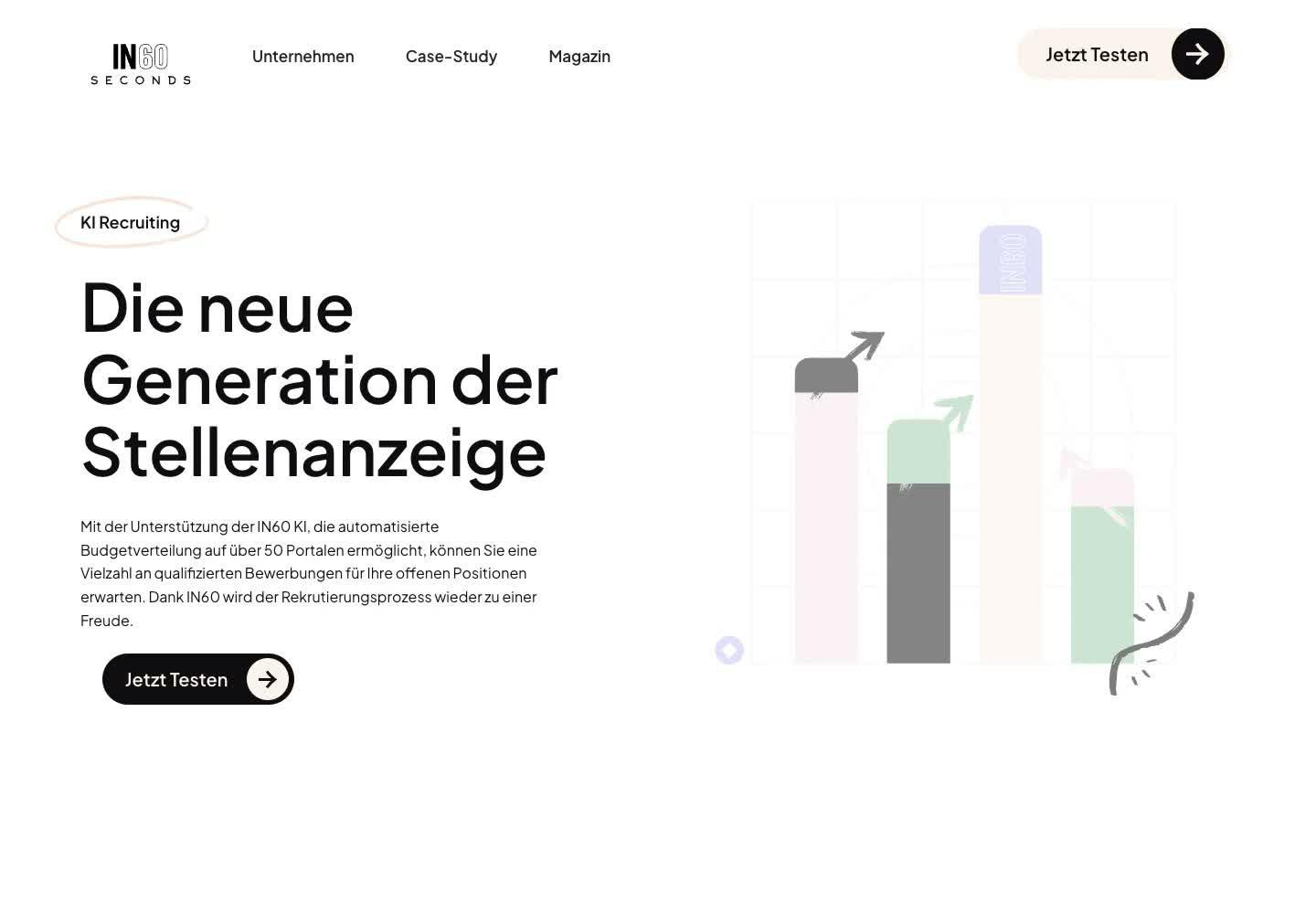
For the recruitment consultancy Palantec, we gave data, technology and finance one visual platform before employers and candidates follow their own journeys. For the recruiting platform IN60, product views, applicant management screens and original campaign examples make the offer tangible for HR teams.
Palantec
Specialisation you recognise immediately.
What a strong recruitment agency website needs.
Separate paths to conversion
One route for employers, one for candidates. Each has a single goal, a search brief or an application, with a clear button on every page.
A page per specialism
Every sector or discipline gets its own page with typical roles, experience and a named contact. It ranks on Google and convinces employers to give you the mandate.
A job board that converts
Filters by field and location, readable job ads and an apply button that is always visible. Optionally connected to your applicant tracking system.
Quick mobile application
A few questions, CV optional, sent in moments. Applications go straight to your team.
A short route to the brief
An explained search process and a short enquiry form for employers. New mandates reach your business development team, separate from CVs.
Tracked campaign landing pages
Dedicated pages for social recruiting ads, matched to each message. GA4 and conversion tracking show which campaign brings applications.
A recruitment agency website has a harder job than most company sites. It has to convince two very different people: the managing director or HR lead with a hard-to-fill role, and the professional deciding whether to trust you with their details. They arrive with different questions, on different devices and through different channels. This guide covers what matters in structure, specialism, the job board and the application flow, and how your site should work alongside recruiting campaigns. The examples come from our projects for Palantec and IN60.
01Recruitment agency website design starts with two audiences
The most important decision sits at the top of the page: who is visiting right now? Employers want to know whether you understand their market, how you search and how quickly you deliver. Candidates want to browse vacancies, understand how you handle their data and know what happens after they apply. A good site separates these journeys early, with two clear entry points in the navigation and on the homepage.
At Palantec, employers and candidates each have their own page with a dedicated illustration and process. The employer page explains the search in six stages, while the candidate page shows six steps from first contact to starting a new role. Each audience gets its answers without wading through content meant for the other.
02Staffing agency website: make your specialism obvious
Recruitment runs on trust. Employers would rather hand a mandate to someone who speaks their industry than to a generalist. A staffing agency website should therefore lead with its areas of expertise: dedicated pages for sectors or role families, with typical positions, relevant experience and a named consultant.
For Palantec, data, technology and actuarial services share one visual language of large typography and animated illustrations, so the positioning is clear from the opening screen. Specialism pages also help with search, because employers often look for recruiters in a specific field rather than recruiters in general.
03From hiring need to search brief
For decision makers, your website is often the first impression before they pick up the phone. They want to understand how you work. An explained search process with clear steps removes uncertainty and answers questions that would otherwise take up the first call. Repeated contact points at the end of each section turn interest into an enquiry.
Keep the employer enquiry form short: role, location, timeframe, contact details. Everything else can wait for the conversation. Just as important, keep it separate from the candidate flow so new briefs never get buried under CVs.
04Career site design: vacancies and applications built for mobile
Whether you are an agency or an employer looking for better career site design, most candidates browse jobs on their phone. The job listing needs filters by field and location, readable job ads and an apply button that is always within reach.
The application itself should take only a few steps: a handful of questions, CV optional rather than mandatory, no account required. Every extra hurdle costs applications you need to fill your mandates. We can connect your applicant tracking system. IN60 shows how the path from publishing a vacancy to managing applications can be explained clearly on the website itself.
05HR services website: show the offer in everyday use
Not every recruiting business places people. HR service providers and recruiting platforms sell tools, processes or campaigns, and their website has to make a fairly abstract offer tangible. The most effective way is to show prospects what it looks like in the daily work of their HR team.
For IN60, product views and animations show how budget allocation shifts across channels and how applications are handled in the applicant management system. Industry examples address the questions of different employers. Prospects see the product in action before requesting a consultation, and clear contact points lead from information to conversation.
06Your recruiting website and social recruiting campaigns
Many skilled professionals never search job boards. They are reached through ads on Instagram, Facebook, TikTok or YouTube. A recruiting website has to catch that click with a landing page that continues the message of the ad and an application that works on a phone.
That is why we plan website and campaigns together. Through our Social Recruiting service, we produce videos, run campaigns and build the matching application flows. GA4 and conversion tracking show which channel and which page bring applications and client enquiries, so your budget goes where it leads to placements. IN60 shows campaign examples directly on its site.
Your new recruiting website in four steps.
- 01
Audiences & positioning
We clarify which employers and which candidates you want to reach and what sets your specialism apart. That shapes a structure with separate journeys.
- 02
Structure & copy
We define specialism pages, your search process, the job board and the application flow. Copy speaks to decision makers and candidates in their own terms.
- 03
Design & build
Custom design in your brand world, with animation and illustration where they help. We build for speed and test the application flow on every device.
- 04
Growth after launch
We measure which pages and channels bring client enquiries and applications, then optimise based on the data. If you like, we scale up with social recruiting campaigns.
FAQ: recruitment agency website design
It depends on scope and features, such as the number of specialisms, a job board or an applicant tracking integration. A single page starts in the low four figures, a larger website is above that. After the first call you receive a fixed-price quote.
Through separate entry points in the navigation and on the homepage, dedicated pages with their own copy and separate forms. Employers reach the search brief, candidates reach vacancies and the application. Palantec is a good example.
Through separate paths with one clear goal each, a visible specialism, a short route to the search brief and a mobile application without hurdles. After launch we use GA4 and conversion tracking to see which pages and channels deliver, then optimise accordingly.
Yes. Career site design follows the same principles: a clear vacancy overview, genuine insight into the team and an application that takes only a few steps on mobile.
Candidates answer a few questions, the CV is optional and no login is needed. Applications arrive instantly by email or in your applicant system.
Yes, we plan for it. Campaigns on Instagram, Facebook, TikTok or YouTube lead to dedicated landing pages with a matching message. Through our Social Recruiting service we can also handle videos and campaigns.
Rethink your recruiting website?
Send us your current address. Within 24 hours you get a first assessment of audience journeys, vacancies and the application flow.
Or email us directly: hello@btechnology.de